Showing posts with label once through Cooling Water. Show all posts

Tuesday, May 14, 2013

Pump assisted Siphon in CW System of Turbine.

To understand the content of this post please read Wikipedia Page on Siphon.

Once through CW systems are relatively unknown in Thermal Power Plants being constructed today but there are many old ones. Let us look at following image on Wikipedia page.
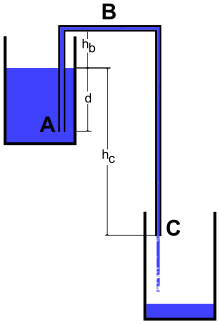
From Wikipedia
B can be the top point of Condenser Water Box and C the end of the outlet pipe.

The Siphon works on the basis of height difference hc. In CW System hc may be zero but the CW Pump Head equal to hc will simulate it.

In case of Siphon both inlet and outlet pipes are under vacuum. In CW System the outlet pipe will be under vacuum but inlet pipe may be under positive pressure or slight vacuum at Condenser inlet.

Since the Cooling Water picks up heat in the Water Box the pressure in Water Box should be higher than Vapour Pressure of Water at Outlet Temperature with some margin.

During Start up Vacuum is created by Condenser Water Box Priming Ejector or Vacuum Pump.

The Priming Ejector/Vacuum Pump needs to be run periodically to remove liberated dissolved gases from Cooling Water from Condenser Water Box.

Recently I visited one Thermal Power Station where I had to tell them the importance of running Water Box Priming Ejector periodically.

Friday, October 26, 2012

Comparison of Condenser Vacuum in Cooling Tower versus once through Cooling Water System.

I am going to mostly write about condensing, reheat turbines with regenerative cycle. Condenser Vacuum is the vital parameter of such machine and let us talk about what is achievable today compared to old power stations.

Once again my memory takes me to Obra. On local panel we use to have a mercury tube indicating as much as 712 mmHg vacuum in December/January. In summer it use to be around 690 mmHg.

Our competitor was Badarpur where it hardly touched 690 mmHg in winter.

I asked the Engineering Department in BHEL Haridwar and they told me that Badarpur Station had Cooling Tower whereas Obra was having once through Cooling Water System and our Cooling Water temperature was very low compared to what the Cooling Tower would give.

After joining Operation Services Department at NTPC Corporate Centre in 1983 and studying the Acceptance Test Codes of Steam Turbine as well as Cooling Tower I realised the real difference.

The temperature of Cooling Water in once through system can be as low as the Wet Bulb Temperature but the Cooling Tower has to be infinitely large to equal that temperature. We had Induced Draft Cooling Towers designed to deliver 33 degC temperature at 27 degC Wet Bulb Temperature. The difference in the two temperature is called approach. The approach was 6 degC at design point but it was increasing as much as 12 degC at 15 degC wet bulb temperatures.

Without the technical jargon it meant that the max temperature in once through system was 27 degC and in Cooling Tower it was 33 degC. In winter the once through system could be lower than 12 degC but in Cooling Tower it hardly went below 25 degC.

The flagship station of NTPC is Singrauli Super Thermal Power Station (SSTPS) and it has once through Cooling Water system. In modern times there is hardly any station with once through system, therefore, it is my advice that you don't compare the Condenser Vacuum of your station with SSTPS unless you have similar Cooling Water System.

At Jharsuguda we have Natural Draft Cooling Towers. This tower is also built to deliver 33 degC at design point but its performance depends upon both the Dry Bulb and Wet Bulb temperatures. The reason being variation in air flow which is constant in Induced Draft Cooling Towers unless you touch the fan.

In worst weather i.e. both Dry and Wet Bulb Temperatures on higher side the Natural Draft Cooling Tower delivers higher temperature compared to Induced Draft Cooling Tower but in Winter it delivers lower temperature due to increased air flow.

But the most important aspect of Cooling Tower System is fouling in Condenser Tubes unless you religiously maintain residual Chlorine.

As Turbine Maintenance In-charge at NTPC Vindhyachal Super Thermal Power Station (VSTPS) Stage 1 (6x210 MW) I could not maintain the Chlorination because it was 2 Km long underground pipe failing frequently.

This resulted into slime formation in Condenser Tubes which initiates fouling. I introduced tube cleaning with High Pressure Jet Pumps and got very good Condenser Vacuum but it used to deteriorate within three months in the absence of residual chlorine.

At Jharsuguda we have Sodium Hypo-chloride dozing system which is also having underground piping but thanks to the Chemistry Department which maintains residual chlorine by manual dozing if there are leakages in underground pipes.

Update on 27th May 2013
Since I had seen very good Vacuum at Obra and Singrauli I was under the impression that once through Cooling Water Systems provide better Vacuum but after visiting Tuticorin the belief is broken.

I was expecting better measured value of Condenser Vacuum at Tuticorin because at seashore the atmospheric pressure is maximum. What you see in the gauge or indication in Control Room is the difference between the Turbine Back Pressure and atmospheric pressure. Other things being equal i.e. for same absolute back pressure (say 0.09 ata) what you read at Singrauli (for atmospheric pressure of 1.0126 ata) will be -0.9226 Kg/cm2 and at Tuticorin (for atmospheric pressure of 1.033 ata) it should be -0.943 Kg/cm2.

Although I found my familiar mercury in glass Vacuum Gauge at Tuticorin and expected better than 690 mmHg, it was disappointing to see 660 mmHg.

On analysis I found CW Pump assisted Siphon formation in Condensers Water Box and the practice of not running Water Box Priming Ejector periodically to remove liberated dissolved gases.